
Convenience Store Chains Bet on Retail Media: Opportunities and Costs in 2023
As the digital advertising landscape evolves, convenience store chains like Casey's and 7-Eleven are launching retail media networks, leveraging high-frequency store visits and impulse purchase scenarios to attract advertisers. However, experts point out that this field faces challenges including scarce talent, difficulties for smaller operators to scale, and insufficient loyalty data, while also requiring a careful balance between advertising and the shopping experience.
As consumer shopping habits shift online, data privacy regulations tighten, and third-party cookies are phased out, advertisers' desire for high-ROI advertising channels is intensifying. The convenience store industry has keenly noticed this trend and is positioning Retail Media as a key growth engine for 2023. However, pioneering this emerging field is not without obstacles, with challenges lurking in areas such as talent, scale, and customer experience.
This report is the second in a series focusing on key trends in the convenience store industry for 2023.
Retail Media: The New Growth Pole for Convenience Stores
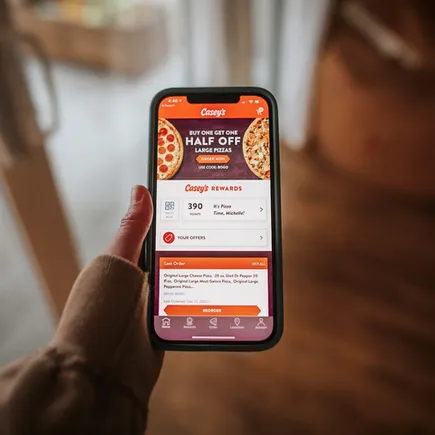
Art Sebastian, Vice President of Digital Experience at Casey's General Stores, said that his team foresaw the dramatic shift in the advertising landscape years ago, and that brands' pursuit of higher return on investment (ROI) was "not surprising." After more than two years of preparation—including building a digital ordering experience, optimizing the customer interface, and introducing AI-enhanced shopper insights—Casey's officially launched its retail media network, "Casey's Access," this year. This makes it the second major U.S. convenience store chain to venture into retail media, following 7-Eleven.
Casey's Access opens its first-party customer data to CPG companies and other suppliers, enabling them to precisely create and target promotions, offers, and marketing content, similar to 7-Eleven's retail media network model. Although many convenience store operators are still unfamiliar with retail media, market research firm Emarketer predicts that digital ad spending flowing through retail media networks will exceed $61 billion by 2024.
"Retail media is a massive, long-term trend in marketing. According to any analyst firm's data, it will be the fastest or second-fastest growing channel across all marketing budgets," said Michael Greene, Senior Vice President of Global Vertical Strategy at commerce media company Criteo. "You reach consumers at the most critical moment in their shopping journey—right when they are about to make a purchase."
Retail media networks are poised to be the most exciting new tool for convenience store operators in 2023, bringing growth and opportunity, but experts caution that the potential rewards come with equally significant challenges and risks.
High Visit Frequency and Impulse Buying: The Unique Advantages of Convenience Stores
Compared to retail media focus areas like grocery stores or big-box retailers, convenience store operators possess several unique advantages, one of which is the high visit frequency of their core customers.
"In the grocery industry, if a customer comes in to restock every 7 to 10 days, that's enough to make you happy," said Sebastian, who joined Casey's in 2018 after working for grocers like Jewel Osco, Albertsons, and Meijer for two decades. In contrast, the best convenience store customers visit multiple times a week, "which means there's a high-frequency interaction relationship between the customer and the brand." Sebastian emphasized that this high frequency makes it more likely for convenience stores to frequently display ads and drive engagement with customers compared to other retailers. "I think this is extremely unique to our channel," he said.
Furthermore, consumers visiting convenience stores are often driven by impulse purchases, which also benefits retail media. Jordan Berke, Founder and CEO of Tomorrow Retail Consulting, pointed out that since convenience stores focus on immediate consumption, advertisers can achieve high profit margins because customers are likely to visit the store and make a purchase within hours of seeing an ad. "This isn't planned purchasing," Berke said. "It's 'I need it right now.'"
Fuel service is another touchpoint that convenience stores can integrate into their retail media efforts. Casey's installed video screens on its fuel pumps years ago, laying the groundwork for the launch of Casey's Access. "We did that intentionally because we knew that someday we would light up those screens with personalized content," Sebastian said. He emphasized the importance of leveraging fuel stop time for in-store media marketing: "If a customer's tank is empty, they start the pump and begin fueling, we have a captive audience, and they're already on the premises. Pushing the right content at that moment is a huge opportunity to drive conversion from the pump to the store."
Paul Brenner, President and Chief Strategy Officer of Vibenomics, also sees fuel as a major opportunity for convenience store retail media, but he acknowledged that retailers must better connect entertainment and ads at the pump with in-store merchandise, treating the gas station as a "programmatic clearinghouse." "If you want to leverage the pump, you have to take more creative measures to guide customers into the store," he said. "It has to be a continuation of the experience."
Talent Shortage: Professional Expertise as a Bottleneck
The retail media field is still emerging, and convenience store operators often rely on a mix of internal marketing staff and external talent to manage it. Brenner said he has never seen a retailer build a retail media network without partnering with a third-party service provider. Although some third-party companies offer white-label services, giving retailers more control over the project, the work involving coding and "connecting the dots and moving parts" often goes beyond the retailer's expertise. Even in media sales, where retailers might be slightly more competent, they still need to bring in third-party vendors.
To advance Casey's Access, Casey's chose third-party vendor CitrusAd, whose "best practices and implementation team" provided strong support. CitrusAd has also built retail media networks for companies like Hy-Vee, ShopRite, Lowe's, Kohl's, AT&T, and Bed Bath & Beyond. But this doesn't mean Casey's doesn't have its own team involved. "We manage our own paid media, so we have employees who understand the space," Sebastian said. "We have people with digital marketing backgrounds, and we already have a viable mix of talent internally."
Casey's having employees with retail media experience puts it ahead of the industry. Greene noted that historically, when companies ventured into retail media, internal marketing or merchandising teams were often "thrown" into new roles or given new responsibilities and told to "figure it out." "That was an experiment," he said. "It was like, 'Go find someone who's eager to do this, understands the business, understands relationships, and see what they can do.'"
But as more retailers enter retail media, some are beginning to realize the need to "professionalize" their workforce. Greene said retailers are increasingly hiring talent with digital media backgrounds, even poaching from major tech companies like Google. He believes that if convenience stores want to scale their retail media businesses, bringing in such specialized talent is essential. "This can't be a side project," Greene emphasized. "It requires specialized skills, and you build the business on that foundation."
Pressure on Smaller Players: Scale and Loyalty Challenges
Berke pointed out that the fundamental challenge for convenience store operators is that the retail media business is vastly different from traditional retail operations. Bridging this gap requires "a lot of learning and investment," which favors larger operators with capital and learning capacity, while smaller operators need to be more strategic. He suggested that smaller operators could join forces with other independent or regional brands to form retail media networks, because advertisers can only handle a limited number of platforms at a time. "Advertisers can't deal with thousands of small advertising channels," Berke said. "You have to find a way to become meaningful, with enough reach, data, and trust to compete."
Brenner agreed that smaller retailers with fewer assets find it harder to launch retail media networks. He mentioned that many of Vibenomics' convenience store clients—some with hundreds of locations—struggle to scale for these reasons. "Convenience stores need to see broad participation from many small groups to get the attention needed in the retail media space," he said.
Another challenge is that convenience stores have lower loyalty membership engagement compared to industries like restaurants and grocery. Since first-party loyalty data is directly linked to retail media programs, increasing loyalty engagement should be a top priority for any convenience store creating a retail media program. "The only value of retail media is having first-party data about your customers," Brenner said. "I need to know that a customer comes in twice a week and buys a specific item."
Beyond investment, loyalty, and scaling challenges, retail media networks also come with risks. Greene warned that the most serious risk could be disrupting the shopping experience, thereby harming the core business. He described that even testing a retail media program is a "leap of faith" for many retailers. Mitigating risk requires an "art of balance," involving a lot of trial and error. He advised operators to move forward in small steps, avoiding anything that undermines the core mission or alienates customers. "You want to acquire customers and retain them," Greene said. "This is an area where all retailers, including convenience stores, should be cautious."
It was with these considerations in mind that Casey's prepared for two years before launching its retail media network. "For a project like this, you have to take the time, and that's why we've been very careful," Sebastian said.
Data and Advertising Innovation: Future Directions
When retail media networks mature and become profitable, where does innovation manifest? Greene observed that as networks grow, retailers are investing in new, high-value ad formats, creating incremental opportunities for brands. "We're seeing many retailers experimenting with adding video ad units to their websites," Greene said. "Two years ago, that was unimaginable."
Additionally, Greene found that as retail media networks develop, retailers are focusing more on data monetization—applying loyalty data to digital ad formats like social channels or connected TV (CTV). Some retailers are even offering brands new shopper insights that go beyond transaction data. Walmart is a non-convenience-store example of this stage; Greene mentioned its Luminate product, which uses advanced data science to synthesize omnichannel insights. "How do we use data to influence the planning process of brands or agencies?" Greene said. "How do we go beyond audience data to bring in shelf data programmatically?"
Despite continuous innovation in loyalty data application, Brenner believes that innovation in retail media ultimately boils down to one thing: "Delivering results for advertisers—as long as it delivers results."
Correction: An earlier version of this report misspelled Michael Greene's surname.

