
Gum manufacturers respond to sales decline challenges with innovation
The gum industry faces the challenge of long-term consumption decline. Although sales have rebounded after the pandemic, consumer interest remains below historical peaks. Hershey has launched Flavor Shifters, its biggest innovation in five years, which attracts consumers through flavor changes during chewing. Mars Wrigley is attempting to break the monotonous experience of traditional gum through strategies such as Skittles-flavored crossovers, Simply's use of natural ingredients, and Maax's addition of caffeine. Industry experts point out that truly breakthrough innovation may come from startups, while large companies may absorb new trends through acquisitions.
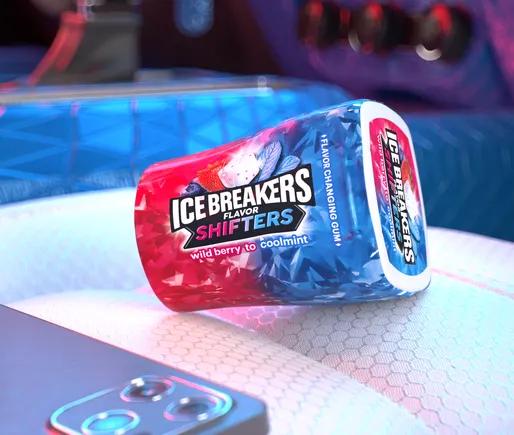
Hershey Co. is launching its biggest innovation in five years for its Ice Breakers gum brand, and one executive is not hiding expectations for the new product: "We expect this to make a huge splash." The product, called Flavor Shifters, changes flavor during chewing, from wild berry to cool mint, or from wintergreen to cool mint.
For a gum category that has long relied on new flavors or new packaging as its primary innovation, Flavor Shifters, which hit the market this month, attempts a completely new path.
"We're targeting consumers who are bored with their gum and fresh breath habits. How do we re-engage them? How do we bring excitement?" said Dan Mohnshine, vice president of marketing for Hershey's U.S. confection, grocery, and protein snacks, in an interview. Hershey calls Flavor Shifters a "major bet" for the Ice Breakers brand, which has seen annual growth of 9% since 2020. Mohnshine said the innovation "pushes the boundaries of gum," expanding the category beyond a single-flavor experience.
"We're targeting consumers who are bored with their gum and fresh breath habits. How do we re-engage them? How do we bring excitement?"
— Dan Mohnshine, Vice President of Marketing, U.S. Confection, Grocery, and Protein Snacks, Hershey
During the pandemic, gum sales suffered because consumers at home no longer needed fresh breath for work, dates, or time with friends and family. In 2020, sales plummeted 22% to $2.5 billion, according to data from analytics firm Circana. Mars Wrigley's chief brand officer, Rankin Carroll, told The Wall Street Journal in June that lockdowns also reduced impulse purchases in stores, which account for half of gum sales.
But as more people returned to offices and resumed socializing, gum sales have rebounded to above pre-pandemic levels. Sales grew about 15% in 2022 and 2023 and rose 7% in the 52 weeks ending June 16 of this year, reaching $3.4 billion, according to Circana data.
Despite the rebound, gum's popularity has been declining for years since peaking over a decade ago. In 2011, 178 million Americans reported chewing gum, according to Statista. This year, only 157 million are expected to chew gum.
"Traditional stick gum, nobody gets excited about it," said Tim Lawdan, brand manager at Ford Gum, maker of the shredded gum Big League Chew.
 Source: Mars.com
Goodbye Fruit Stripe, hello caffeinated gum
The gum decline has prompted several companies to exit the category entirely. Mondelez International, after struggling for years to grow brands like Bubblicious and Trident, sold its gum business in the U.S., Canada, and Europe in October 2023 for $1.4 billion to focus on its booming chocolate and cookie businesses. Ferrara also quietly discontinued Fruit Stripe and Super Bubble gum in 2022.
"This decision was not made lightly, and we considered many factors, including consumer preferences, purchasing patterns, and overall brand trends," Ferrara spokesperson Brian Camen said at the time.
For companies that remain, like Mars Wrigley, this creates opportunity. Mars Wrigley is the world's largest gum manufacturer, with over a dozen brands including Hubba Bubba, Extra, Big Red, and Orbit.
Mike Gilroy, vice president of trade development and sponsorship at Mars Wrigley, said the New Jersey-based company recently launched Hubba Bubba gum that incorporates flavors from its popular hard candy Skittles. Leveraging Skittles' high popularity among Gen Z consumers, Mars Wrigley can use its recognition to bring original flavors to gum, giving people a reason to try Hubba Bubba—some of whom may not have chewed it in years.
"As the clear leader in the gum market, we not only need to innovate in gum to attract new users, but also take a leadership role in category health," Gilroy said.
Dan McCarthy, associate professor of marketing at the University of Maryland, said for the gum category to achieve meaningful growth, it must embrace other value propositions, such as caffeine or improving tooth and gum health.
Florida-based Maax Brands launched its performance-enhancing gum in 2021, after its founder was driving home one night and wanted a pick-me-up. Carrying a cup of coffee isn't always convenient, especially when out socializing, and coffee doesn't provide the freshest breath either. Each piece of Maax gum contains the equivalent of 1.25 cups of coffee's caffeine, along with 1 gram of sugar to help offset the stimulant's notoriously bitter taste.
"Part of the challenge is ensuring the gum delivers an energy boost while also tasting good to the chewer, because no one wants to chew bitter gum and have bitter breath," said Maria Cuesta, head of marketing at Maax.
McCarthy said that for large companies, adding attributes like caffeine carries risk because they are reluctant to invest in new products that may not gain consumer acceptance. Instead, truly novel gum innovations may come from smaller startups.
"I wouldn't be surprised to see a lot of innovation coming from outside and then being acquired by a company like Wrigley," he added. Large gum manufacturers would "selectively make bolt-on acquisitions of brands that seem to be gaining traction."
Few gum brands have been as innovative in recent years as Simply. Karsten Ch'ien, vice president of sales and growth at the New York-based company, said Simply ditches the synthetic plastic base used in most gums in favor of chicle. It also avoids artificial flavors, colors, and sweeteners like aspartame, using organic raw cane sugar instead. Most of its gums have no more than six ingredients.
 Source: Christopher Doering/Food Dive
Simply also stands out with its flavor combinations, designed to attract new users to the category. While it offers common gum flavors like mint, other flavors are more unique, including grapefruit, maple, anise, and ginger. Ch'ien said these features have helped Simply achieve high double-digit growth, making it the best-selling natural gum brand in the U.S.
However, Simply's success did not happen overnight. Unlike most gums that come in bright colors, Simply is a dull tan. Its shape is also different, resembling small logs. The company spent months convincing retailers and consumers that despite the unusual color and shape, these features should not be a barrier to purchase or sale. Today, the 10-year-old brand is sold in 13,000 stores including Walmart, Publix, Whole Foods, and Target.
"We've proven that consumers are willing to be more open to the possibilities of gum," Ch'ien said.
Changing for today's consumers
Established gum brands are also realizing that being more open is key to survival. Big League Chew has a strong following among adult consumers who chewed the shredded bubble gum as kids. But until recently, it struggled to find a place with the children and teens who are crucial to its future, leading to stagnant sales.
In 2022, Ford Gum, the manufacturer, seller, and marketer of Big League Chew, realized the brand was not resonating with its target consumers. It gave the beloved childhood product a major overhaul to make it more appealing to today's shoppers while maintaining the nostalgic connection with parents and grandparents.
"Our top priority was to revitalize this (34-year-old) brand," Lawdan said. "It has great awareness; everyone knows it. But what we're really focused on is ensuring a new generation of kids grows up with it like our parents' generation did."
 Source: Courtesy of Ford Gum
To do this, Ford established partnerships with elite college athletes that 13- and 14-year-old baseball players closely follow. It increased its presence on social media, showcasing not just the gum but also athletes having fun using the brand. Big League Chew launched more limited-edition products, including a mint flavor, to make it a year-round product rather than just a baseball season treat.
Ford also completely overhauled the popular packaging that had not changed in nearly two decades. The pouches now feature new player cartoons, which the company says better reflect today's consumers.
These changes are paying off. Sales are up double digits year over year, and Big League Chew has added distribution in channels like Lowe's and Food Lion. Executives say there is further growth opportunity in convenience stores, and the brand has not yet entered major chains like Walmart and Target.
"The key is making it something kids want to chew, not just a novelty, but like 'No, I'm not going to baseball practice without Big League Chew in my bag,' creating a FOMO element without the product," Lawdan said. "When you compare Big League Chew to other gum brands, it really stands out."