
Why are Casey's, QuikTrip, and RaceTrac all betting on travel centers?
Traditional convenience store chains like Casey's, QuikTrip, and RaceTrac are actively expanding their travel center businesses. Large travel centers offer more space, more merchandise and food service, and lucrative diesel profits, and are seen as long-term assets in response to the electric vehicle transition. Despite challenges such as high construction costs, labor shortages, and competitive barriers, experts believe this trend will continue.
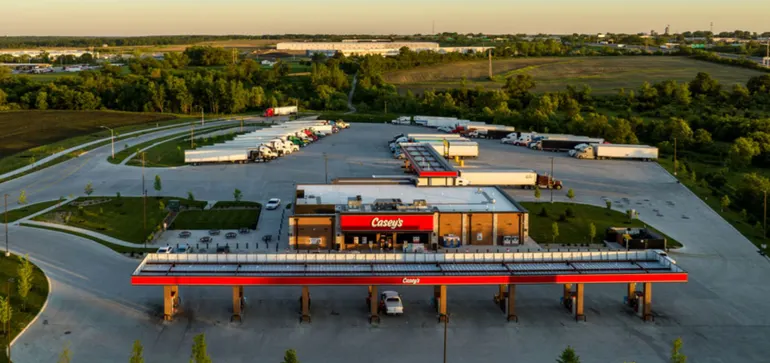
Held in late JuneCasey's General Stores Investor DayAs it drew to a close, CEO Darren Rebelez showed the convenience store industry the store format the Midwest retail giant will focus on in the coming years. Travel centers larger than 7,000 square feet are the direction Casey's is expanding toward, Rebelez said.
Although he did not disclose how many such stores Casey's currently has—as of press time, a spokesperson for the retailer did not respond to inquiries—Rebelez mentioned that Casey's already owns some travel centers and they have performed well so far.
"We think this is a good opportunity for us," Rebelez said. "They are significantly more expensive to develop, but they have much higher traffic, and they are exponentially higher in prepared food because that is a big need for long-haul drivers."
Casey's is not the only traditional convenience store retailer making a major push into travel centers.
QuikTrip, which has been in the travel center business since the 1990s, launched its "remote" travel center concept in 2020. The model has grown rapidly since then and has become a priority for the company's future, corporate communications manager Aisha Jefferson-Smith said in an interview. Jefferson-Smith explained that the difference between QuikTrip's two travel center formats is that remote locations are built only in new markets, specifically targeting areas near its food distribution centers. To date, QuikTrip has a total of 96 travel centers.
"We expect a bright future for QuikTrip because the new remote store network plan has already been launched," Jefferson-Smith said.
Meanwhile, RaceTrac had three travel centers in 2021 and now has 25 truck stops in its network, a company spokesperson said in an interview. Although not disclosing further details on growth plans, the spokesperson emphasized that "travel centers are the future of the company."
For decades, convenience stores and travel centers operated relatively independently due to different customer bases: the former catered to motorists making quick purchases, while the latter served truck drivers needing longer stops. But over the past few years, these two segments seem to have been converging, with traditional convenience store operators like Casey's, QuikTrip, and RaceTrac moving into the travel center space. Multiple experts and industry leaders believe this move makes sense for these operators.
Just ask Casey's.
"Clean restrooms, prepared food, showers, laundry facilities, secure parking—these are exactly the attractions of travel centers," Rebelez said. "We provide these services at our truck stops and will continue to expand in this area."
The allure of high profits
Multiple experts agree that, if operated properly, the potential profitability of travel centers is far higher than that of traditional convenience stores. This is likely one of the primary reasons traditional convenience store operators are increasingly investing in this format. But why are travel centers so profitable? Experts point out that the core factors are their scale and traffic, which far exceed those of traditional convenience stores.
The average convenience store is typically about 3,000 square feet, while a typical travel center is often twice that size. And depending on location, many sites see up to 40,000 vehicles pass by daily, said Darren Schulte, vice president of membership at the National Association of Truck Stop Operators (NATSO). "Compared to traditional convenience stores, the potential customer base is enormous, and that is a factor to consider," Schulte said.
Experts also note that travel centers have diversified profit centers because their size allows them to offer more products and services to both truck drivers and regular motorists. Jeremie Myhren, former CIO of Road Ranger and co-founder of truck payment company OnRamp, said in an interview that a typical convenience store might offer 7,000 SKUs, while a travel center can typically reach 20,000, generating more revenue simply because of the larger space.

Beyond merchandise, the large space of travel centers also benefits food service. Schulte said a convenience store might have a quick-service restaurant and an in-store proprietary food program, while a travel center might have up to three different QSR brands, a dine-in restaurant, and its own food program. "Food offerings and food revenue are significantly higher than at convenience stores," Schulte noted.
The high profit margins of travel centers also stem from their fuel sales volume. For example, truck drivers average about 105 gallons per fill-up, while regular drivers average about 13 gallons, Myhren said. He noted that diesel margins in the U.S. have been at historic highs for a long time, which in itself is enough to attract convenience store operators into the travel center space.
"The diesel margin is there," said Peter Rasmussen, former marketing manager at Wawa and founder and CEO of convenience store consulting firm Convenience and Energy Advisors. "You supply more diesel—filling up a trailer with 200 gallons is certainly exciting."
Building travel centers is not cheap. Myhren said costs typically run about $10 million per site depending on the scope of facilities, compared to about $5 million for a standard convenience store. But once a site is operational—and if it is in an ideal location along a major highway—the return on capital can be "exponentially higher" than a standard convenience store. "I think many people have realized this, and that is the fundamental driver behind traditional convenience store retailers entering this space," he said.
Energy transition considerations
In the face of climate change, the energy transition is underway, with more and more companies globally investing in electric vehicle charging projects. In the convenience store industry, EV charging has become one of the focal points over the past few years, as retailers work to adapt andprepare for a future where gasoline may become obsolete. Multiple experts point out that while electrification inevitably threatens the trucking industry, its adoption is much slower than for passenger vehicles, meaning diesel-powered vehicles and their associated fueling stations will last longer.
"Convenience store operators are thinking: 'My convenience store may be hurt by changes in future mobility, but travel centers have a longer lifespan and will exist longer,'" Schulte said.
Even if electrification eventually dominates trucking, long-haul drivers or truckers driving for hours on end will still go to highway sites—the heart of travel centers—to charge, said Roy Strasburger, former convenience store operator and CEO of retail services company StrasGlobal. This differs from urban consumers, who may prefer to charge at home, work, or other locations.
"Sites outside cities will continue to be popular and continue to grow," Strasburger said. "EV charging on highways will be a big trend."
Investing in travel centers for EV charging may also help traditional convenience store retailersachieve profitability in electrification, something many retailers have struggled to do so far, said Lisa Biggs, former retailer and president and CEO of convenience store consulting firm Impact21. She noted that large travel centers with multiple facilities—from more merchandise and food service to sanitation or vehicle maintenance—may attract highway drivers needing to charge more than urban EV drivers.
"We want consumers to stay longer, and EV is a natural complement," Biggs said. "Travel centers have been doing this for years. It is more complementary than any large store we have had in the past."
In February, oil giant BP acquired TravelCenters of America for $1.3 billion. At the time, BP CEO Bernard Looney said the acquisition was to build "mobility hubs of the future"—a network that would allow BP to grow its convenience, bioenergy, EV charging, and hydrogen "growth engines" to become an integrated energy company. Looking ahead, Myhren believes other travel centers will adopt similar strategies. He noted that the future of travel centers is what he calls an "energy oasis"—accommodating all forms of energy—something standard convenience stores cannot achieve. "That is one reason to support larger sites," Myhren said.
Is the competition real?
Although brands like Casey's, QuikTrip, and RaceTrac are building travel center networks, experts expect these retailers will not pose much of a competitive threat to established truck stops like Pilot and Love's Travel Stops & Country Stores. At a macro level, this is because brands like Pilot and Love's have fuel supply agreements with trucking companies, meaning those truck drivers must fuel at the contracted chain. Rasmussen said this greatly reduces the likelihood that Casey's or QuikTrip, even if opening next to a Pilot or Love's, could take business away from the established brands.
"That is why sometimes you see a line of trucks queuing at Pilot, while the diesel pumps at an independent truck stop across the street are empty," Rasmussen said. "It is simply because truck drivers have no choice."
Strasburger agreed, noting that fuel supply contracts and trucking companies' loyalty to partner brands are competitive barriers. "I am not sure how many truck drivers would switch to convenience store brands," Strasburger said. "They may feel these brands cannot meet their needs, do not fit the image, and do not have loyalty programs like truck stops."
While experts like Rasmussen and Strasburger expect limited competition between traditional convenience stores and major travel center brands, it is a different story for independent truck stop companies, which often lack fuel supply agreements. "If Casey's, RaceTrac, or QuikTrip opened across the street, I would be scared because they would have newer and nicer stores," Rasmussen said. "They would operate more efficiently than I would."

Although there may not be much competition between traditional convenience store players and established travel center brands, Schulte believes that truck stop retailers like Pilot investing instore renovationsand ambitious growth plans in recent years is no coincidence. He believes major players like Pilot and Love's will welcome the challenge brought by traditional convenience store operators like Casey's, RaceTrac, and QuikTrip. "There is nothing better than sharpening your own saw," Schulte said. "I believe these chains see it as competition and also as an opportunity to improve, which elevates the entire industry."
Not an easy task
Beyond lacking the fuel supply agreements that Pilot and Love's have, traditional retailers investing in travel centers face other challenges. First, travel centers are a completely different business, Strasburger said. Convenience stores have historically been designed for quick visits, while travel centers require facilities and space for truck drivers to stay for extended periods and need more resources than a standard convenience store. "There are more moving parts in the business," Strasburger said. "You are not just running a convenience store and food service program; you are managing truck driver lounges, showers, and everything else, from a management and organizational standpoint."
Because travel centers are much larger than standard convenience stores, convenience retailers entering the truck stop space need to consider issues such as parking layout, facility types, and the number of food options, Schulte said. "These operators encounter many different challenges once they enter the travel center space," he noted.
Another challenge for traditional retailers entering travel centers is staffing, Strasburger said. Such sites ideally need 50 to 60 people to operate and are typically located in rural, sparsely populated areas, making it potentially difficult to find enough employees. Additionally, Strasburger noted that equipping sites with appropriate fueling equipment such as high-speed diesel pumps and satellite pumps can be quite expensive. "I think the two big challenges are financial and... keeping enough staff to ensure smooth operations," he said.
Although Strasburger also foresees this trend continuing, he warns convenience store retailers to ensure they do not cannibalize their own market when joining the truck stop wave. "Convenience store operators tend to cluster stores together for unified management," he said. "If you build a truck stop every 50 miles, you will take away customers who would otherwise stop every 100 or 200 miles."
The convenience store industry is under financial pressure—experts say retailers shouldprepare for inflation for the rest of the year. But as convenience store retailers continue to focus on expanding their store networks, buying or building travel centers could be a solution to boost profits. "If you only have so much capital each year for new stores, why not?" Rasmussen said.