
Why convenience stores are increasingly adding food services: responding to declining fuel demand and instant delivery competition
Declining fuel demand and instant delivery competition are forcing convenience stores to reposition. Industry expert Frank Beard writes that food services will become the core growth area for convenience stores to move away from fuel dependence and address structural challenges, and he analyzes industry differentiation trends and innovation practices of leading brands.
This is a guest article by Frank Beard. Beard is a retail analyst, speaker, and writer based in Des Moines, Iowa, currently working in marketing and customer experience at Standard AI.
I have a particular fondness for struggling traditional retailers. I believe many readers share this feeling: walking into the stores of brands that were once thriving but now frequently appear in headlines about the "retail apocalypse" feels like stepping into a time machine. They seem to still be running on momentum from the past, mistaking "existence" for "relevance." In 2018, before my local Toys "R" Us closed permanently, I noticed the cash registers were still on those aging counters—where I had placed my Nintendo 64 game cartridges back in 1996.

I often think about these things when visiting convenience stores. Despite innovative brands like Sheetz, Wawa, Casey's, Kum & Go, and Buc-ee's, I still see many stores offering a "nostalgia trip" just like those traditional retailers. However, they seem immune to the wave of disruption that has devastated many local malls and department stores.
I find the resilience of convenience store retail fascinating, mainly attributable to two factors: a strong moat built through fuel sales—an advantage those struggling local malls never had—and extreme proximity to consumers.93%of Americans live within a ten-minute drive of a convenience store, and even the most basic "cigarettes and soda" product mix remains relevant in impulse purchase and immediate need scenarios, something e-commerce has historically struggled to disrupt.
But this landscape is changing. Convenience store retailers now face two potentially disruptive headwinds that, in my view, need to be carefully addressed.

Challenges to the traditional business model
The ability of fuel pumps to attract customers is likely to decline. On one hand, demand for fuel from internal combustion engines is weakening. The U.S. Energy Information Administration (EIA)forecaststhat by 2040, fuel economy for light-duty vehicles will improve by 47%. On the other hand, consumers are beginning to adopt electric vehicles that don't need fuel at all.
The latter point is particularly noteworthy. There is currently a debate in the industry about what role convenience stores should play in the supply of public charging stations. While on the surface, adding charging stations at "gas stations" sounds forward-thinking, the viability of the business model can easily be questioned.
Convenience stores currently sell80% of U.S. gasoline, but it's hard to imagine them charging 80% of American electric vehicles. Retailers will have to compete with home charging, workplace charging, and many other businesses offering charging services. Furthermore, charging seems better suited for places where vehicles are parked for extended periods. While a more robust charging network is necessary as a safety net, it's hard to see why the average EV owner a decade from now would need to regularly stop to "refuel" during their daily commute from point A to point B.
Even in Norway, the most mature EV market globally, reports indicate thatup to 65%of EV owners living in apartments charge at home weekly or more frequently. This new dynamic was also described in Alimentation Couche-Tard's recentInvestor Day presentation: 55-75% of charging activity will happen at home, 20-35% at destinations, and 10-20% en route.
No one can say for sure how this transition will unfold. Will diesel demand remain resilient? Perhaps. Will internal combustion engines have along exit ramp? Possibly. Will other energy sources join in? Maybe. But when I talk privately with retailers, I hear strong skepticism about the unit economics and potential demand for public charging stations.

Moving from the fuel pump to the store, convenience stores face another challenge: "on-demand" delivery companies are competing for the industry's$255.6 billionin in-store sales. The risk is not outright disruption, but being seen as the "inconvenient option." What happens when late-night beer runs shift to delivery, or when some busy locals decide the time cost is higher than Gopuff or DashMart fees? Retailers need to assess what they would lose if customers can only pay at a physical checkout or if their own delivery solutions aren't competitive enough.
Taken together, these are real structural challenges. The eventual decline in fuel demand could lead to a shakeout in the U.S. convenience store network in areas where home charging becomes widespread. Retailers must become "destinations" for other purposes, and "cigarettes and soda" probably won't be enough. Additionally, the continued growth of on-demand delivery options could significantly erode in-store sales, especially for retailers relying on undifferentiated product mixes.
As retailers seek to use their real estate in new, more effective ways, I expect we'll see a renewed focus on a shift that has been happening over the past few decades and is considered one of the biggest growth areas in convenience store retail.
I'm talking, of course, about foodservice.
"Let's meet for lunch at the gas station"
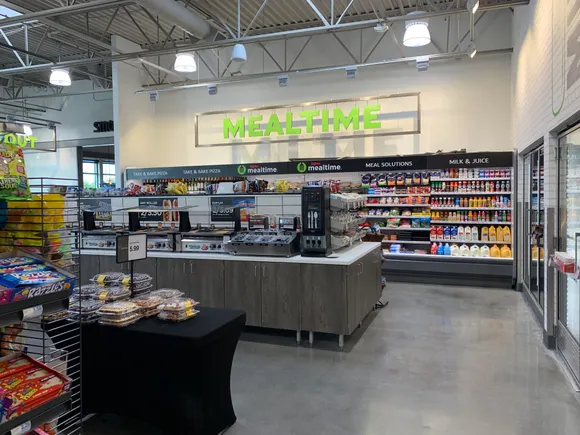
Prepared food in convenience stores is nothing new. But while "gas station" dining used to conjure images of greasy roller hot dogs, today the offerings at many leading retailers rival national fast-food chains—and other retailers are scrambling to catch up.
It's important to understand that the industry is currently diverging in three directions: consolidators, who scale traditional convenience store operations while introducing operational sophistication and favorable fuel supply agreements; food-first retailers, who operate like fast-food brands, pursuing quality in product offerings and customer experience, and earning fuel margins from successful in-store sales; and "merchant fuel stations," which are large fuel plazas in front of big-box retailers like Sam's Club and Costco. All three types are prepared to compete for a larger share as fuel demand shrinks, but the first two also view foodservice as key to their in-store operations.
The food-first segment concentrates most of the foodservice innovation. In fact, many of these retailers have built entire brands around foodservice. They are typically represented by regional private companies that have elevated and redefined industry standards.
Many are early pioneers in foodservice. Sheetz introduced touchscreen ordering as early as1996, and today offers fully customizable, made-to-order meals available during flexible hours. Last week, I had trouble ordering a Bacon McMuffin on the touchscreen at my local McDonald's and had to go to the counter for help; Sheetz customers, meanwhile, can easily build any breakfast sandwich they want, even after 10:30 AM.
In Louisiana, Shop Rite'sBourbon Street Delialso offers touchscreen ordering and customization, along with a genuine Cajun menu that can compete with local full-service restaurants. On my last visit, I enjoyed blackened alligator and boudin sausage in a nicely decorated dining area with a Mardi Gras vibe.
Food-first brands have been particularly aggressive with their coffee programs in recent years. In Tennessee, Twice Daily created a coffee brand called White Bison, even installing pour-over systems and featuring single-origin beans. Casey's recentlyhired top talent from Starbucks, and many of its over 2,300 stores now have bean-to-cup machines. In my neighborhood, I sometimes walk to my local Kum & Go with my laptop—because the naturally lit seating area is much more comfortable than my local Starbucks.
Consolidators, while not often first movers, are also actively engaging in foodservice. I recently tried the breakfast sandwich from Circle K's new Fresh Food Fast program, and I have to say it was quite good. EG Group acquired coffee giant Cumberland Farms in 2019, and 7-Eleven gained Laredo Taco Company through a major acquisition in 2018.

Foodservice opens new doors for retailers seeking to go beyond physical point-of-sale. Notably, none of the top 25 delivery items at Wawa on third-party aggregator platforms come from major consumer packaged goods companies. Instead, the best performers are items fromits own foodservice menu. While the nuances of delivery deserve a separate article, convenience stores also have the potential to become on-demand hubs for communities that Gopuff and DashMart can't reach.
Some food-first retailers and consolidators are also exploring "market" formats to capture spending that would otherwise go to grocery stores. In my market, I've seen some families replace grocery store trips with trips to Kwik Trip—as they expand their footprint in the metro area. Their high-quality, curated product assortment allows customers to buy basic groceries without spending an hour navigating a warehouse store or dealing with chaotic parking lots.
I remember a panel discussion at the National Restaurant Association Show a few years ago where wecited a surveythat found Cumberland Farms' coffee was perceived as higher quality than Dunkin'. One audience member seemed extremely upset at the time, questioning how we dared to make such a claim—after all, how could coffee from a "gas station" possibly beat a well-known brand?
I understand that reaction, but don't be surprised if you wake up tomorrow and find that the best coffee or lunch option also happens to have fuel pumps. Who knows, maybe there will even be charging stations.